



Neurokinin Receptor
NK receptor; Tachykinin receptor
There are three main classes of neurokinin receptors: NK1R (the substance P preferring receptor), NK2R, and NK3R. These tachykinin receptors belong to the class I (rhodopsin-like) G-protein coupled receptor (GPCR) family. The various tachykinins have different binding affinities to the neurokinin receptors: NK1R, NK2R, and NK3R. These neurokinin receptors are in the superfamily of transmembrane G-protein coupled receptors (GPCR) and contain seven transmembrane loops. Neurokinin-1 receptor interacts with the Gαq-protein and induces activation of phospholipase C followed by production of inositol triphosphate (IP3) leading to elevation of intracellular calcium as a second messenger. Further, cyclic AMP (cAMP) is stimulated by NK1R coupled to the Gαs-protein. The neurokinin receptors are expressed on many cell types and tissues.
Neurokinin Receptor Isoform Specific Products
All Product Categories
-
Neurokinin Receptor Inhibitors
(23)
View all products
-
Neurokinin Receptor Agonists
(41)
View all products
-
Neurokinin Receptor Antagonists
(156)
View all products
-
Neurokinin Receptor Activator
(1)
View all products
-
Neurokinin Receptor Modulators
(7)
View all products
-
Neurokinin Receptor Controls
(3)
View all products
-
Neurokinin Receptor Related Products (279)
Related Products (279)

-
Antibodies (4)
-
Neurokinin Receptor Isoform Comparison
-
DNK-333
 0 ImagesCat. No.: HY-128537CAS No.: 398507-81-8DNK-333 is a potent and balanced dual NK1 and NK2 receptor antagonist with IC50 values of 4.8 nM and 5.5 nM, respectively. DNK-333 blocks the Neurokinin A (NKA) (HY-P0197)-induced bronchoconstriction in asthma.
-
Vestipitant mesylate
 0 ImagesCat. No.: HY-12141CAS No.: 334476-64-1Synonyms: GW597599 mesylate; GW597599BVestipitant (GW597599) mesylate is a selective, orally active, and blood-brain barrier penetrant NK1 receptor antagonist. Vestipitant mesylate exhibits high affinity for the human NK1 receptor (pKi: 9.65). Vestipitant mesylate can be used in the research of diseases such as depression, anxiety disorders, and nausea and vomiting.
-
GR 87389
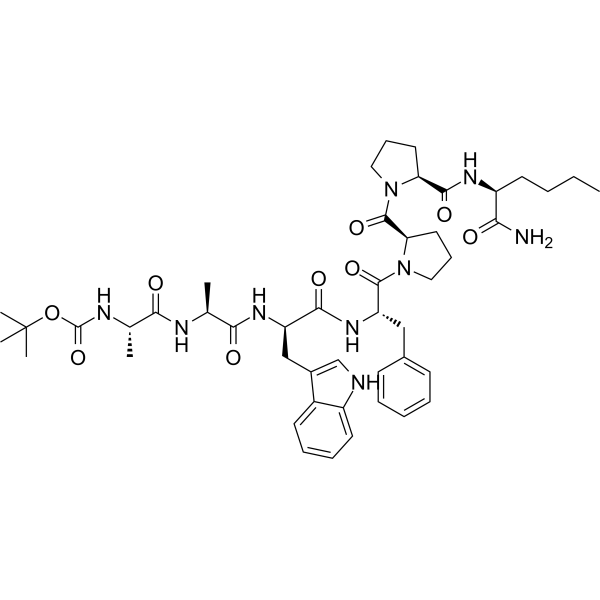 0 ImagesCat. No.: HY-P3853CAS No.: 141663-86-7GR 87389 is a potent NK2 receptor antagonist. GR 87389 antagonized GA 64349-induced smooth muscle strips contractions in a competitive manner in the human detrusor, prostate and prostatic urethra.
-
R116031
 0 ImagesCat. No.: HY-123497CAS No.: 336884-84-5R116031 is a selective Neurokinin-1 (NK-1) receptor antagonist with a Ki of 0.45 nM for human NK-1 receptor. R116031 inhibits Substance P (HY-P0201)-induced peripheral effects (skin reactions and plasma extravasation in guinea pigs) and a central effect (thumping in gerbils).R116031 labeled with 3H significantly accumulate in the striatum, olfactory tubercule, olfactory bulb and locus coeruleus in gerbils models. R116031 can be used as a positron emission tomography (PET) ligand for PET imaging.
-
Bz-Dab(NBD)-AwFpP-Nle-NH2
 0 ImagesCat. No.: HY-P2603CAS No.: 161238-74-0Bz-Dab(NBD)-AwFpP-Nle-NH2 (Compound 5B) is a potent fluorescent antagonist of NK2 receptor, with a pKi of 8.87 nM (Ex=340 nm, Em=505 nm).
![[Asp5,6,Me-Phe8] Substance P (5-11)](https://file.medchemexpress.com/product_pic/hy-p11429.gif "Click to View [Asp5,6,Me-Phe8] Substance P (5-11) Product Detail")
-
L-659837
 0 ImagesCat. No.: HY-P2436CAS No.: 125989-10-8
-
Dilopetine citrate
 0 ImagesCat. No.: HY-105334ACAS No.: 247046-64-6Synonyms: E-6006 citrateDilopetine citrate is an inhibitor of substance P release. Dilopetine citrate dose-dependently reduces the vocalizing of isolated guinea pig pups. Dilopetine citrate shows good activity as an antidepressant.
-
Phenylalanylphenylalanylamide
 0 ImagesCat. No.: HY-129931CAS No.: 15893-46-6Synonyms: H-Phe-Phe-NH2Phenylalanylphenylalanylamide (H-Phe-Phe-NH₂) is a ligand for the substance P 1–7 (SP1-7) binding site with a Ki value of 1.5 nM. Phenylalanylphenylalanylamide exerts significant anti-allodynic and anti-hyperalgesic effects in animal models of neuropathic pain following central administratio. Phenylalanylphenylalanylamide shows no distinct effect after peripheral (intraperitoneal) administration. Phenylalanylphenylalanylamide can be used for research on pain-related diseases.
-
Telmapitant
 0 ImagesCat. No.: HY-129423CAS No.: 552292-58-7Telmapitant is an orally active NK1R antagonist. Telmapitant has antiemetic effect and can be used for the research of delayed onset emesis.
-
rac-Vofopitant-d3
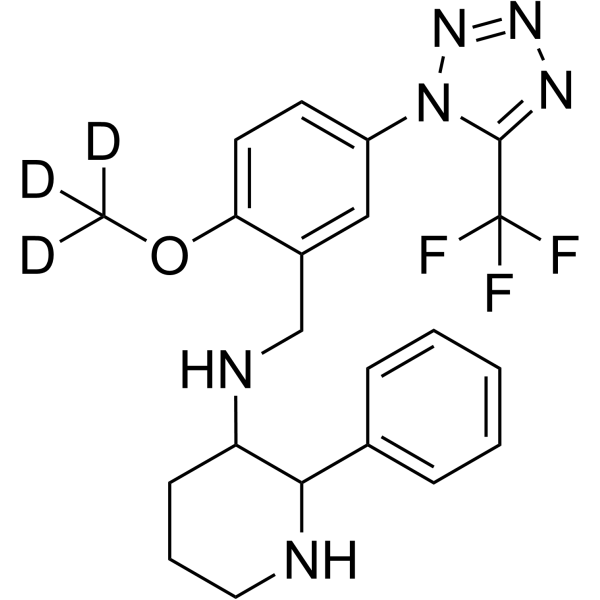 0 ImagesCat. No.: HY-12142SSynonyms: rac-GR 205171-d3rac-Vofopitant-d3 (rac-GR 205171-d3) is a racemic form of deuterated Vofopitant (HY-12142). Vofopitant (GR 205171A) is a blood-brain barrier-permeable NK1 receptor inhibitor with a pKi of 9.02 in mice. Vofopitant blocks vomiting-related responses and inhibits pseudoptyalism. Vofopitant exerts anxiolytic effects, regulates 5-HT receptor function and increases central 5-HT release. Vofopitant improves hyperarousal symptoms of post-traumatic stress disorder. Vofopitant can be used in research related to depression, anxiety, vomiting and postoperative nausea and vomiting.
-
YM-44778
 0 ImagesCat. No.: HY-120167CAS No.: 173941-74-7YM-44778 is a neurokinin receptor antagonist. The pKi values for NK1, NK2 and NK3 are 8.08, 8.55 and 8.24, respectively. YM-44778 inhibits the increase of bladder pressure induced by substance [Sar9,Met(O2)11] -P (HY-P1012) in anestheticized rats.
-
(D-Arg1,D-Pro2,D-Trp7,9,L-Leu11)-Substance P
 0 ImagesCat. No.: HY-P3880CAS No.: 84676-91-5(D-Arg1,D-Pro2,D-Trp7,9,L-Leu11)-Substance P is a neuropeptide Substance P (HY-P0201) antagonist.
-
[D-Pro2,D-Trp7,9] Substance P
![[D-Pro2,D-Trp7,9] Substance P](https://file.medchemexpress.com/product_pic/hy-p3808.gif "Click to View [D-Pro2,D-Trp7,9] Substance P Product Detail") 0 ImagesCat. No.: HY-P3808CAS No.: 80434-86-2[D-Pro2,D-Trp7,9] Substance P, a Substance P (HY-P0201) analogue, is a weak agonist and a potent, specific, competitive Substance P antagonist.
0 ImagesCat. No.: HY-P3808CAS No.: 80434-86-2[D-Pro2,D-Trp7,9] Substance P, a Substance P (HY-P0201) analogue, is a weak agonist and a potent, specific, competitive Substance P antagonist.
-
(Rac)-LM11A-31
 0 ImagesCat. No.: HY-W370556CAS No.: 289475-77-0(Rac)-LM11A-31 is a racemate of LM11A-31. LM11A-31 is a non-peptide modulator of p75NTR (neurotrophin receptor p75) and is an orally effective proNGF antagonist.
-
TAC 363
 0 ImagesCat. No.: HY-180376CAS No.: 172081-08-2TAC 363 is a selective tachykinin NK-2 receptor antagonist. TAC 363 shows a rightward shift in the contractile response curve induced by Neurokinin A (HY-P0197) with a pA2 of 9.82. TAC 363 has a weak antagonistic effect on NK-1 receptors. TAC 363 can inhibit Neurokinin A-induced bronchoconstriction in guinea pigs with an ED50 of 0.3 mg/kg. TAC 363 can be used for the research of bronchial asthma.
-
GSK172981
 0 ImagesCat. No.: HY-121164CAS No.: 1133705-99-3GSK172981 is a brain-penetrant tachykinin NK3 receptor antagonist with pKi values of 7.7 and 7.8 for human and native guinea pig NK3 receptors, respectively. GSK172981 can be used for the study of schizophrenia.
-
Tyr0-Neurokinin A
 0 ImagesCat. No.: HY-P3848CAS No.: 116868-93-0Tyr0-Neurokinin A is a neuropeptide belongs to tachykinin peptide family. Tyr0-Neurokinin A is an agonist of Tacr2. Tyr0-Neurokinin A can be used in the research of insulin resistance, obesity, diabetes.
-
Aprepitant-13C2,d2 (Major)
 0 ImagesCat. No.: HY-W777166CAS No.: 1217676-37-3Synonyms: MK-0869--13C2,d2; MK-869-13C2,d2; L-754030--13C2,d2Aprepitant-13C2,d2 (Major) (MK-0869-13C2,d2) is 13C labeled Aprepitant. Aprepitant (MK-0869) is a selective and high-affinity neurokinin 1 receptor antagonist with a Kd of 86 pM.
-
Elinzanetant (Standard)
 0 ImagesSynonyms: NT-814 (Standard); BAY3427080 (Standard)Elinzanetant (NT-814) Standard is the analytical standard of Elinzanetant (NT-814) (HY-109171). This product is intended for research and analytical applications. Elinzanetant is an orally active and selective NK-1 and NK-3 receptor antagonist. Elinzanetant alleviates menopause-associated vasomotor symptoms, including hot flashes and night sweats. Elinzanetant reduces estradiol and progesterone levels. Elinzanetant can be used for the research of moderate to severe vasomotor and sleep disorders associated with menopause.




